Overview
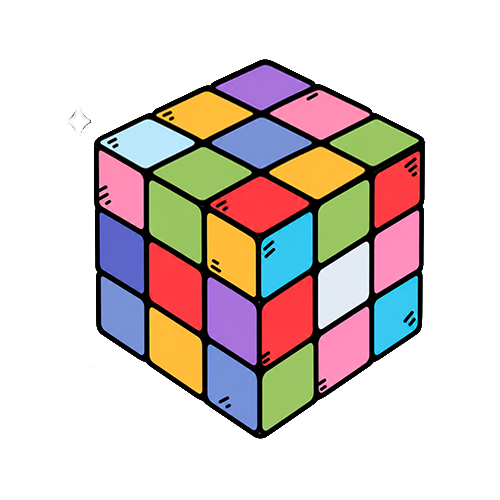
CUBE is a single Rubik's cube whose state lives inside a smart contract. It is shared by everyone: there is exactly one cube, and anyone can pay to turn one of its layers. Every position of every tile is public, verifiable, and changed only by moves that players paid for.
The six colors of the cube define six factions. Players join a faction by staking $CUBE on its color. Each face has a score, which is simply the number of its tiles currently showing the right color. The higher your faction's score, the larger its share of the fees generated by everyone's moves.
A portion of every move accumulates in a locked pot. The pot opens only when the cube is fully solved. At that moment the solver takes a reward, stakers share the rest, and the cube is reborn one size larger. This cycle gives the game its long arc: epoch after epoch, the cube gets bigger, slower, and heavier with value.
The cube
The protocol only uses cubes of odd size. On an odd cube, the center tile of each face never moves, so the center defines the identity of the face forever. The red face is the face whose center is red. This is what makes the notion of a faction stable across thousands of moves.
Scores
The score of a face counts how many of its tiles currently show its own color. On a 3×3 it runs from 1, since the center always matches, to 9 for a perfectly sorted face. The sum of the six scores is the total order of the cube. Order is not a constant: a move can create it or destroy it, which is exactly why cooperation and sabotage are both possible.
The rule that shapes everything
Turning a face never changes that face's own score, and never touches the opposite face. Only the four adjacent faces move. Three consequences follow, and they define the whole game:
- You can never improve your own face by turning it. You must play on your neighbors.
- Every useful move disturbs three rival factions at the same time. There is no free move.
- Each faction has one safe face, its own, and one harmless face, the opposite one.
Sequences
A player can submit a whole sequence of moves in a single transaction and pays for each move in it. Without this, no one could ever execute a long solve without being interrupted halfway.
Factions and staking
Joining is permissionless and there is no fixed ticket: stake any amount of $CUBE on a color and you are in. Your stake makes you a shareholder of that face. Your share of the faction is simply your stake divided by everything staked on that color, and whatever the faction earns streams to its members in that exact proportion. Stake more and your share grows, others stake and it dilutes, always pro rata.
Exit delay
Leaving a faction, or switching colors, takes a delay. Without it, the best strategy would be trivial: wait, then hop onto whichever color just went up. The delay forces players to commit before they know the outcome, which is what makes picking a side meaningful.
Time weighting
Rewards are computed on a time weighted average of your stake, not on a snapshot. Entering huge amounts right before a distribution and leaving right after earns almost nothing. Loyalty is measurable on chain, and it pays.
Claims
Nothing is ever pushed to wallets automatically. The contract keeps an accumulator per color and every member claims whenever they want. This is deliberate: automatic distribution loops are a classic attack surface, and claiming is the only pattern that scales safely.
Move economics
Every move is paid in $CUBE at a dynamic price. When recent activity is above target the price climbs, and when the cube goes quiet the price decays back toward a floor. Congestion pricing is the only anti spam protection that cannot be dodged by splitting funds across wallets, because it depends on no identity at all.
| Destination | Share | Purpose |
|---|---|---|
| Burned | ~30% | Supply shrinks with every conflict |
| The pot | ~30% | Builds the prize of the current epoch |
| The factions | ~40% | Streams to the six colors by score |
| The team | 0% | No fee switch exists in the contracts |
The faction share is divided by score: a face at 9/9 earns nine times more than a face at 1/9. The gap is brutal on purpose. It is what makes score desirable, and therefore what keeps the cube in permanent conflict.
Solving and epochs
The cube is solved when all six faces reach their maximum score at the same time. Anyone can solve, including someone who never staked and never played a single move before.
The countdown that needs no date
Two numbers face each other publicly at all times: the pot, and the estimated cost of a full solve at the current move price. When activity is high the pot swells. When activity dies the move price decays, so the cost of solving falls while the pot stays put. Sooner or later solving becomes profitable, someone takes the prize, and a new epoch begins. Quiet periods do not kill the game: they mechanically produce its next big event.
Solve protection
A solving sequence submitted in the open could be copied from the mempool and stolen. The protocol uses a commit and reveal scheme instead: the solver first submits a hash of the sequence bound to the current cube state, then reveals it after a short delay. If someone moves the cube in between, the reveal simply fails. Racing to solve stays risky, and that risk is part of the game.
Payout and expansion
| On solve | Share |
|---|---|
| The solver | ~20% |
| All factions, weighted by time staked | ~70% |
| Burned | ~10% |
After payout, the cube grows to the next odd size: 3×3, then 5×5, then 7×7 and beyond. Stakes carry over between epochs and faction history accumulates forever. A 3×3 is always solvable in at most 20 moves, a proven result, so the first epochs resolve quickly. Larger cubes need hundreds of moves, so each following epoch naturally runs longer and carries a bigger pot.
The token
$CUBE is the only currency of the protocol. Moves are paid in it, factions are joined by staking it, the pot is denominated in it, and rewards are claimed in it. Remove the token and nothing remains: no move, no faction, no pot. There is no version of CUBE without $CUBE.
- Supply only shrinks: every move burns a share, and every solve burns part of the pot.
- Stakes and the pot lock large amounts of supply for as long as the game is played.
- No transfer tax, no rebasing, no blacklist, no pause function. Plain and boring on purpose.
- Team allocation, if any, comes from the initial supply, vested and disclosed before launch. The team never takes a cut of the flows.
What CUBE is not
CUBE has no external revenue. It captures no trading fees and taxes no outside activity. All the money that ever leaves the cube first entered it, minus what was burned along the way. It is a closed economy, the same shape as a poker table, and we would rather state it than disguise it.
- Nothing here is yield. What a faction earns is a share of what other players paid to move.
- No mechanism guarantees any price to go up. Burning scales with activity, and so does everything else.
- CUBE is a game with stakes. Play with money you are ready to lose to a cube.
Status
| Piece | State |
|---|---|
| Protocol design | Complete, this document |
| Contracts | In development, immutable by design |
| Economic simulation | In progress, epoch length calibration |
| App | Live as a preview, all writes locked |
| $CUBE token | Not live |
The app already lets you connect a wallet, pick a faction, and watch the cube. Staking and moves stay locked until the token launches. When it does, the first cube will be scrambled, the factions will open, and the first move will be playable within a minute.